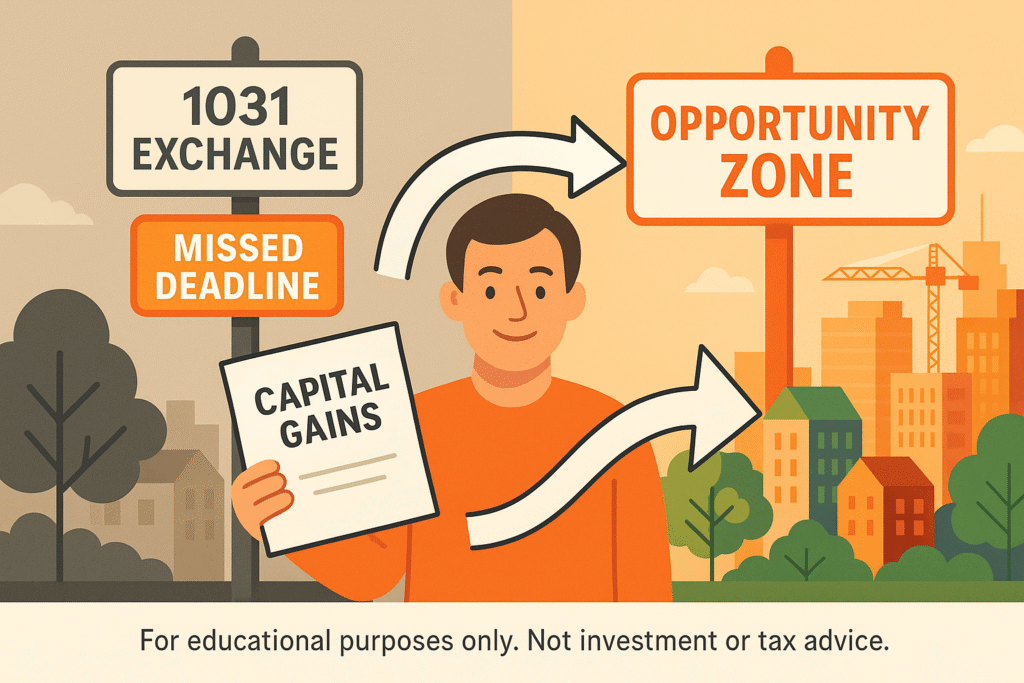
You sold an investment property.
The money hit your account.
And only after closing did someone ask:
“So… who’s your Qualified Intermediary for the 1031?”
If you didn’t engage a QI before closing, you’re out of luck on a traditional 1031 exchange. The IRS is unforgiving on that point.
But that doesn’t automatically mean you’ve lost every tax-deferral option.
For many real estate owners in this situation, Qualified Opportunity Zone (QOZ) funds can act as a last-ditch strategy to defer capital gains and potentially eliminate tax on future growth—even after you’ve already taken possession of your sale proceeds.
This article walks through:
- What a QOZ and Qualified Opportunity Fund (QOF) actually are
- How the rules have changed over time, including under the “One Big Beautiful Bill Act” (OBBBA) in 2025
- How an investor who blew their 1031 can still use a QOF to defer capital gains
- The real limitations and risks (this is powerful, but not a magic pill)
- How Orvida Investment Advisors helps investors decide if and how QOZ funds fit into their bigger plan
As always, this is educational only—not tax, legal, or investment advice. You should speak with your CPA and advisors before taking action.
- Quick refresher: What is a Qualified Opportunity Zone & Opportunity Fund?
Qualified Opportunity Zones (QOZs) are specific census tracts designated by the U.S. Treasury as “economically distressed” communities. The idea, originally created under the Tax Cuts and Jobs Act of 2017 (TCJA), was to drive long-term private investment into these areas by offering tax incentives to investors who reinvest capital gains into those zones via a fund structure.
A Qualified Opportunity Fund (QOF) is a partnership or corporation that:
- Elects QOF status on its tax return, and
- Invests at least 90% of its assets into qualifying businesses or properties located in QOZs.
As an investor, you don’t buy the QOZ real estate directly.
You invest your capital gain into the QOF, and the QOF deploys that capital into qualifying projects.
- The core tax benefits (especially relevant if you just sold a property)
Under current law (for gains recognized through December 31, 2026), QOZ investing offers three big levers: Deferral of your original capital gain
-
- If you reinvest an eligible capital gain into a QOF within 180 days of realizing that gain, you can elect to defer the tax.
- For gains recognized before 2027, that deferral lasts until the earlier of:
- When you sell your QOF investment, or
- December 31, 2026 (the original “end date” for this version of the program).
- Partial reduction of that deferred gain (legacy rules)
- Under the original 2017 rules, investors who held QOF interests for long enough could get a 10% or 15% step-up in basis on the deferred gain.
- In practice, because of timing, many investors coming in late to the program never fully captured these early-bird perks—and OBBBA changes the framework going forward (more on that below).
- Potential elimination of tax on future appreciation
- If you hold your QOF investment for at least 10 years, you can generally step up your basis in the QOF to its fair market value when you exit—meaning the growth inside the QOF can be sold income-tax-free.
Think of it this way:
- Original gain from the property you sold → can be deferred for a period and possibly modestly reduced.
- Future gain inside the QOF → can potentially be eliminated if you stay in long enough and follow the rules.
- What changed under the “One Big Beautiful Bill Act”?
In July 2025, the One Big Beautiful Bill Act (OBBBA) was signed into law and fundamentally reshaped the long-term landscape for Opportunity Zones.
Key high-level changes:
- The Opportunity Zone program is now permanent
- The program no longer simply “dies” after 2026.
- Zone designations will be refreshed every 10 years
- New QOZ maps will be drawn on a decennial schedule, with more stringent criteria to better target truly distressed communities.
- New regime for gains recognized on or after January 1, 2027
For post-2026 gains: -
- Gain invested in a QOF can be deferred up to five years (a rolling 5-year deferral instead of a fixed 2026 “cliff”).
- If you hold your QOF interest at least five years, you get a:
- 10% basis step-up on the deferred gain for standard QOFs
- 30% basis step-up for Qualified Rural Opportunity Funds (QROFs)—a new category with enhanced benefits for rural areas.
- The 10-year gain exclusion on QOF appreciation remains, and OBBBA further clarifies that you can exclude that “future gain” even if you hold beyond a fixed end date (subject to a 30-year outer window).
- Heavier reporting requirements for funds
- QOFs (and QROFs) now face expanded annual reporting, with real penalties for non-compliance—aimed at increasing transparency and accountability.
For an individual real estate owner, the practical takeaway is:
If your gain is from a sale before 2027, you’re still under the “old” framework with deferral effectively ending in 2026.
If your gain is from 2027 and beyond, you’re playing under the newer OBBBA rules with rolling 5-year deferral and updated basis step-ups.
- “I missed my 1031—can a QOZ fund still help me?”
Yes—if the timing works, a QOF can absolutely act as a “last-ditch” deferral tool.
Here’s why it’s so powerful for someone who already took the sale proceeds:
4.1 You don’t need a Qualified Intermediary
Unlike a 1031 exchange:
- You can take possession of the sale proceeds.
- You can park them in your bank account temporarily.
- You still may be able to defer the gain—if you reinvest that gain into a QOF within the 180-day window and file the appropriate election with your tax return.
That alone makes QOZ funds a lifeline for investors who:
- Closed without a QI,
- Lost their 1031 because they missed identification or closing deadlines, or
- Decided post-closing that they don’t want another hands-on property.
4.2 You only have to reinvest the gain, not the full proceeds
In a 1031, you generally need to roll over the full net sale proceeds and match or exceed your debt to fully defer.
With QOZ:
- You reinvest capital gains (short- or long-term) into the QOF.
- You can keep your return of basis (your original cost) and invest only the taxable gain portion, if that aligns with your plan.
For many sellers, that means:
- Some liquidity for other goals, while
- Still getting deferral on the “painful” tax piece.
4.3 High-level step-by-step
Very simplified, the process looks like this:
- Confirm your gain and timing
- Work with your CPA to determine:
- The exact amount of eligible capital gain from the sale
- The start date for your 180-day window (usually the closing date for a direct property sale).
- Work with your CPA to determine:
- Decide how much gain to roll into a QOF
- You don’t have to invest all of it—but your deferral applies only to the portion invested.
- Evaluate QOZ funds
- Not all QOFs are created equal. You need to diligence:
- Asset type (multifamily, industrial, operating business, etc.)
- Market and project assumptions
- Sponsor track record and fees
- Fund structure and alignment with your time horizon and risk tolerance.
- Not all QOFs are created equal. You need to diligence:
- Make the QOF investment within 180 days
- Capital actually needs to be funded into the QOF during your window.
- Make the proper election with your tax return
- Your CPA will file the relevant IRS forms (e.g., Form 8949, Form 8997) to elect deferral.
- Important limitations: Why QOZ funds are not a magic pill
The marketing around Opportunity Zones can sound like a miracle cure. The reality is more nuanced.
Here are some key limitations you should understand:
5.1 You still eventually pay tax on the original gain (under current-program rules)
For gains recognized before 2027, deferral only lasts until the earlier of:
- When you sell your QOF interest, or
- December 31, 2026—at which point the deferred gain becomes taxable.
So a QOF can delay the tax hit and potentially tweak the effective rate (depending on basis adjustments and your wider tax profile), but it doesn’t make your original gain “disappear” under the existing regime.
Under the OBBBA regime (for gains recognized after 2026), you get a rolling 5-year deferral and a 10% (or 30% for rural funds) reduction in the deferred gain if you hold the QOF long enough—but again, the original gain is not fully forgiven.
5.2 The 10-year “tax-free growth” only applies to the new QOF investment
The famous “no tax after 10 years” rule is about the appreciation of your QOF interest—not the original gain you rolled in. You’re essentially trading:
- A time-limited deferral (and small potential reduction) on old gain,
- For a chance at tax-free growth on new investments in distressed areas.
5.3 180-day timing is strict
Miss the 180-day window, and your ability to defer that particular gain is gone. There can be alternative start dates for certain pass-through gains, but the deadlines are still rigid and technical.
5.4 These are typically illiquid, higher-risk investments
- QOFs often invest in ground-up development or substantial value-add projects in markets that are, by definition, economically distressed.
- Capital is usually locked up for 10+ years if you want the full benefit.
- Returns can be very project- and sponsor-dependent.
If you’re looking for short-term liquidity or low volatility, a QOZ fund is usually the wrong tool.
5.5 Complex rules, fund compliance risk, and policy risk
- The statutory and regulatory framework is complex and has already evolved significantly since 2017, with additional changes and reporting burdens under OBBBA.
- If a fund fails to meet its QOF/QOZ requirements, investors can lose the associated tax benefits.
- Future regulatory or legislative changes could further impact how attractive these structures are.
5.6 State-tax treatment can differ
Some states don’t fully conform to the federal Opportunity Zone rules, which can blunt the overall benefit depending on where you file.
- When might a QOZ fund make sense for a former landlord?
For a real estate owner who missed their 1031, a QOZ fund can be especially compelling when:
- You want to defer a large capital gain and are comfortable with a long-term, illiquid investment.
- You want a partial cash-out of your downleg, or don’t want to roll all your sale proceeds into a 1031 exchange property.
- You don’t want another hands-on property and like the idea of being a passive investor.
- You are open to impact-oriented investing in communities that need capital, provided the underwriting and sponsor quality meet institutional standards.
- You’re thinking about multi-decade planning—retirement, legacy, or estate strategies where tax-free growth over 10–20+ years is valuable.
It is not a fit for:
- Short-term cash needs
- Investors uncomfortable with development risk or policy risk
- Situations where the tax tail is wagging the dog (the deal still has to be a good deal on its own merits)
- How Orvida Investment Advisors helps investors navigate QOZ decisions
Qualified Opportunity Zones sit at the intersection of complex tax law and esoteric real estate/operating-business underwriting. That’s exactly where we live.
At Orvida Investment Advisors, we help real estate owners who:
- Sold or are selling investment property
- Missed (or decided against) a 1031 exchange, or
- Want to evaluate 1031 vs. QOZ vs. other structures as part of a bigger strategic plan
Our work typically includes:
- Strategic scenario analysis
- Comparing your “do nothing and pay the tax” scenario against QOZ and other deferral strategies.
- Modeling after-tax, after-fee outcomes over 5, 10, 20+ years.
- Institutional-quality review of QOZ funds
- Evaluating sponsor track record, project pipeline, fee load, leverage, and downside risks.
- Identifying whether a given QOF’s strategy truly aligns with your income goals, risk tolerance, and liquidity needs.
- Integration with your overall portfolio and estate plan
- Making sure the QOZ sleeve fits with the real estate portion of your retirement and estate plan.
- Coordinating with your CPA, attorney, and other advisors to implement properly.
- Next steps: Talk to us about whether a QOZ strategy makes sense for you
If you:
- Recently sold an investment property,
- Did not set up a 1031 exchange, or
- Are worried you’re about to write a massive check to the IRS without understanding your alternatives—
…it may be worth a focused conversation about whether a Qualified Opportunity Zone fund could play a useful role in your 2025–2027 planning and beyond.
Orvida Investment Advisors specializes in complex real estate-driven tax strategies—1031s, DSTs/TICs, UPREITs, and QOZ funds—and we approach these decisions with both a fiduciary and institutional underwriting mindset.
If you’d like to explore whether a QOZ investment fits your situation:
- Contact us through orvidacapital.com or
- Reach out directly to schedule a confidential, no-obligation consultation.
Important Disclosures:
This article is for educational purposes only and is not tax, legal, or investment advice, nor is it an offer to buy or sell any security. Qualified Opportunity Zone rules are complex and subject to change; the summary above omits many technical details and exceptions. You should consult your own tax advisor, legal counsel, and financial professional before making any investment or tax-related decision.